
· Naomi Carter
How to Choose a Matcha Whisk: Prong Count, Bamboo, and Shape
In product photos, every bamboo whisk looks like every other bamboo whisk: a pale handle, a bloom of fine tines, a coil at the center. The differences that decide how your matcha turns out are counted rather than seen at a glance — in the number of tines, the color of the bamboo, and the curl carved into the tips.
This guide covers the decisions you make before a whisk ever touches water. How to move it once it does is the job of our matcha whisk technique guide.
What a chasen has to do
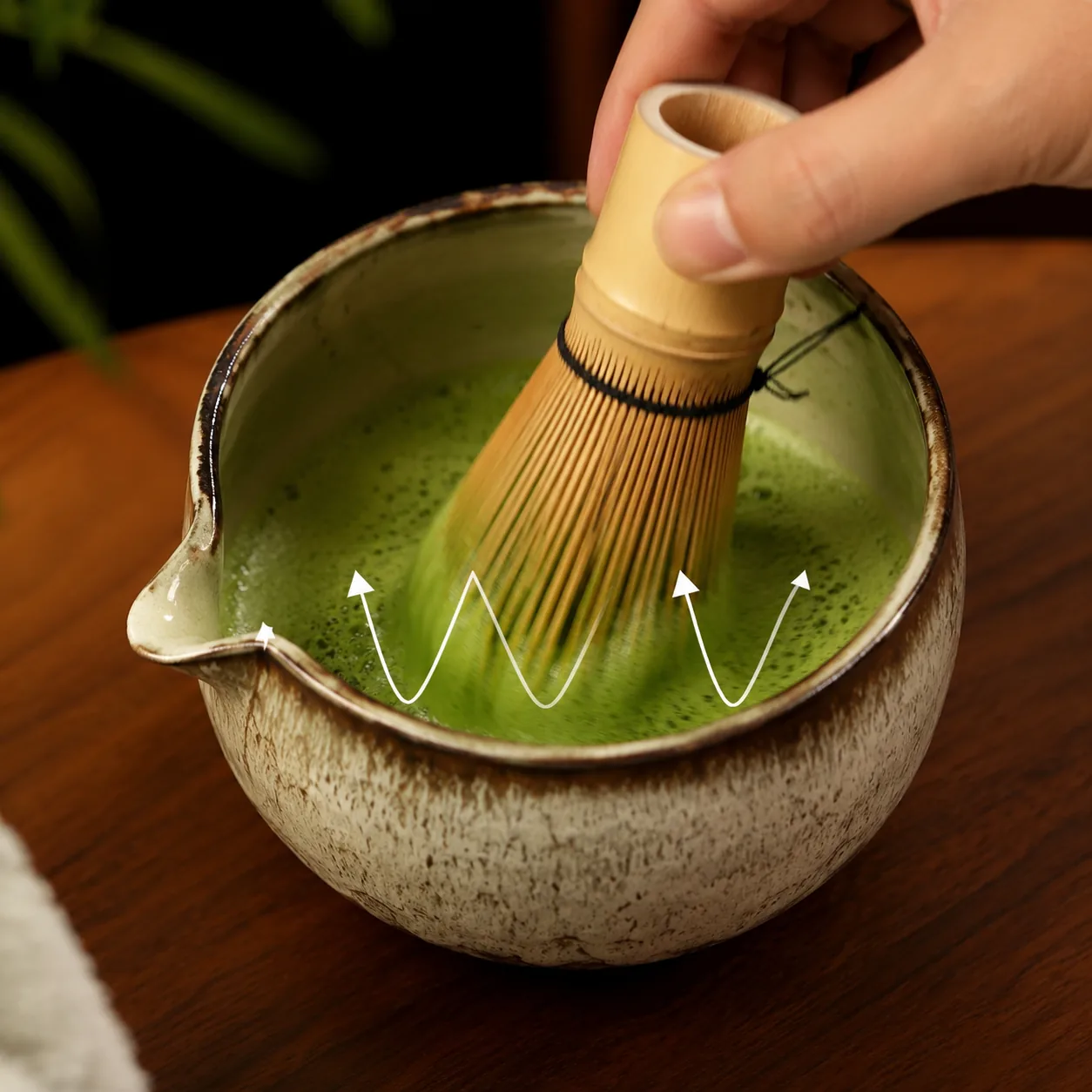
Matcha is a suspension, not an infusion. There is no tea bag doing slow work; there is powder, water, and about thirty seconds of fast zigzag motion. The whisk's tines have to be thin enough to slice through the liquid at speed, springy enough to snap back on every stroke, and arranged so that dozens of tips agitate the surface at once. That agitation is what raises foam.
Every choice below is a trade along those lines. More tines means each tine is thinner, faster through the water, better at raising a fine crema. Fewer tines means each one is thicker and stiffer, better at pushing through a dense paste. The whisk you should buy depends on which of those jobs describes the matcha you actually drink.
Prong count: 80, 100, or 120
The counts trace back to how the tea is prepared. Usucha, the thin whisked matcha most people drink daily, uses a small dose of powder in a larger volume of water and asks the whisk for speed and foam. Koicha, the thick style served in formal tea practice, roughly doubles the powder into less water and asks the whisk to knead rather than froth. Tea-school whisks for koicha run far below the retail range — some traditional patterns carry only a few dozen deliberately coarse tines. The dosing side of that split lives in our chashaku scoop guide.
| Tine count | The tines themselves | What it favors |
|---|---|---|
| ~80 | Thicker, stiffer, wider spacing | Koicha's dense paste, and first whisks that forgive a pressing wrist |
| ~100 | The balance point: fine but resilient | Everyday usucha — the count most home kits standardize on |
| ~120 | Thinnest and most numerous | The finest foam cap, for usucha drinkers chasing texture |
If you drink usucha at home, the practical range is 100 and up. The extra tines do real, physical work: more tips crossing the surface per stroke means finer bubbles from the same effort. The 80 earns its place the day you start preparing koicha, or if your first weeks of whisking tend to press the tines hard into the ceramic, a habit our technique guide trains out quickly.
The bamboo: white, smoked, or black
Nearly all of this craft flows from one place. Takayama, in Nara prefecture, has carved chasen for roughly 500 years and still accounts for over 90% of Japan's production; the counts, shapes, and bamboo grades every modern whisk follows were standardized there. Whisks in the Takayama tradition are split, shaved, and curled from a single section of bamboo, and the material grades carry meaning inside tea practice: the different schools of tea each favor their own bamboo, with smoked susutake — aged for decades above the hearths of old farmhouses — among the most prized.
For a home drinker, the ranking is simpler. White bamboo whisks froth exactly as well as darker ones; what you give up with the rarer bamboos is money, not foam. Color says nothing about durability either — lifespan is decided almost entirely by habits, because soap and heat dry any bamboo into brittleness. Our whisk cleaning guide covers the warm-water routine that keeps the tines springy for months.
Tine shape: curled tips, straight tips, and the center coil
Hold a whisk sideways and look at the silhouette. On a standard kazuho-pattern chasen, the outer ring of tines bows outward and the very tips hook gently back toward the center, like a wave caught mid-curl. That curl is functional: it presents the tips to the surface of the liquid at whisking angle, and the surface is where air gets folded in. Straight-cut tips exist mostly in formal tea-school patterns, carved to each school's specification rather than for faster foam.
The center of the head tells you about care in the carving. The inner tines gather around a tight coil, bound with thread — traditionally black or white — and that binding should sit snug with no loose ends or gaps. Splayed inner tines or a slack thread mean the head will lose its geometry sooner. And if you are inspecting a whisk you already own whose tips have curled the wrong way — inward, into a closed tulip — that is a drying problem rather than a carving one, and our whisk reshaping guide walks through the recovery.
Size, spring, and the checks that matter on arrival
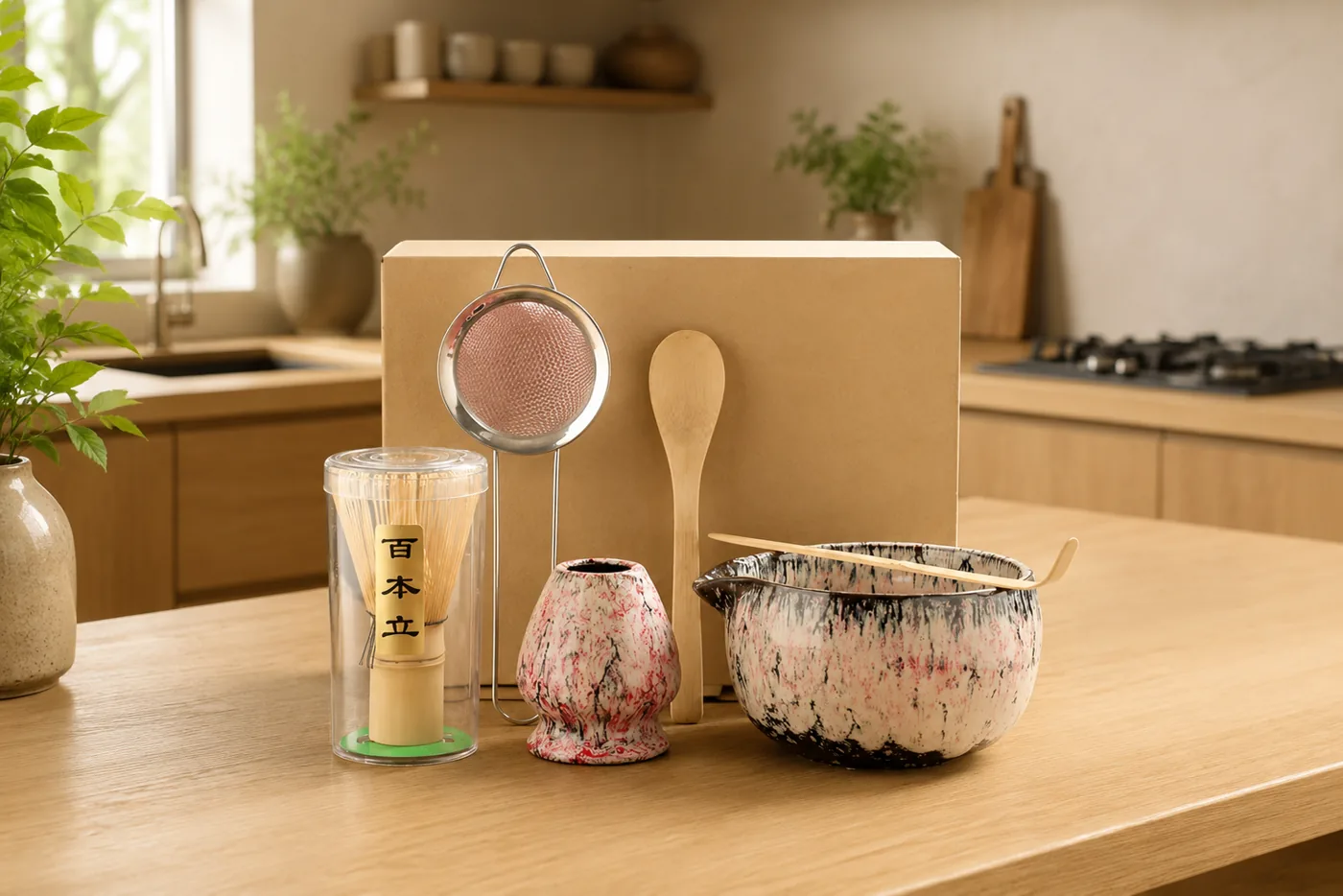
Length matters less than proportion. A standard-length whisk paired with a wide-mouthed bowl gives your wrist room for the zigzag stroke; the spouted bowl in our set opens to 13 cm across for exactly that reason. Miniature travel whisks and oversized display pieces both exist at the edges of the market, but the standard size earns its dominance: it fits the bowls, the holders, and the hand.
Then there is the inspection a spec sheet cannot do for you. Turn the whisk head-down and look at the tines end-on: the spacing should read as an even ring, without clumps or gaps. Flex one outer tine a few millimeters with a fingertip: it should bend and return, not creak or stay bent. Smell the head: dry bamboo smells faintly of grass and nothing else. And slide the whisk out of its plastic shipping tube on day one — the tube is packaging, and every hour a whisk spends sealed in it after first use works against the shape, as our whisk storage guide explains.
The numbers behind this guide
of Japan's chasen production comes from Takayama, Nara, where whisks have been hand-carved for roughly 500 years — the prong counts and shapes in this guide are that tradition's taxonomy
— KOGEI JAPAN traditional crafts directory, 2026
the bamboo chasen included in our complete 6-piece matcha set, the standard home-kit size that pairs with its 13 cm spouted bowl and 7.5 cm whisk holder
— KujiMatcha product spec sheet, 2026
verified orders for the complete matcha set, rated 4.9/5 by verified buyers
— KujiMatcha order data, 2026
Match the whisk, then give it somewhere to dry
The decision compresses well. Drink usucha daily: a standard-size whisk around the 100 count, white bamboo, kazuho curl. Plan to knead koicha, or know your wrist starts heavy: step down toward 80. Chase the finest possible foam: step up to 120 and treat the thinner tines gently. In every case, check spacing, spring, and thread when it arrives.
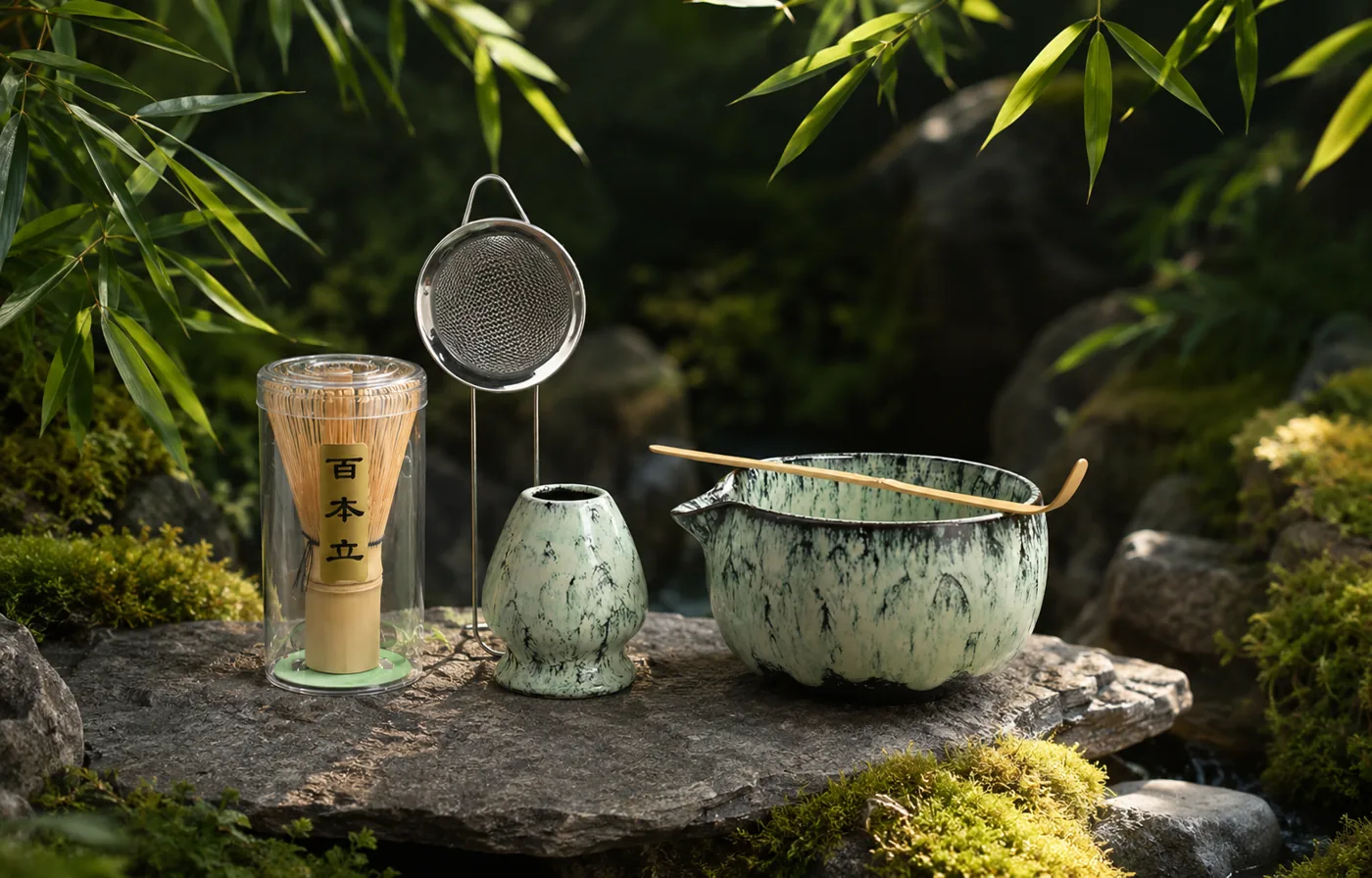
If you would rather make one decision than four, that is the reasoning already built into our complete 6-piece matcha set — a standard 10.66 cm bamboo chasen alongside the spouted bowl it fits, a sieve, a bamboo teaspoon, a chashaku, and a matching ceramic rest, at $49.95 in five glazes. Buyer photos of all five are on our reviews page, and if the kit is a present, the matcha gift set guide covers who it suits.
One purchase follows the whisk no matter which count you chose. Bamboo dries into whatever position it is left in, so the whisk that whips your foam in month three is the one that spent months one and two drying tines-down over a dome. That is the whole job of the chasen holder, the piece Japanese tea practice calls a kuse naoshi, and ours is the glazed ceramic whisk holder at $14.95 in ten glazes. Choose the whisk for the tea you drink; keep it whisking with the rest it dries on.
Whisk buying questions, answered
How many prongs should a first matcha whisk have?
Around 100. It is the count most kits standardize on because it froths thin matcha (usucha) with an easy wrist and still holds up to daily use. Pick 80 if you plan to knead thick koicha, and 120 if the last degree of foam fineness matters to you.
Does a higher prong count make a chasen more fragile?
The tines are thinner, so they flex more and shed slightly sooner under rough handling, but count is a small factor next to habits. Soap, boiling water, and drying in a closed tube retire whisks of every count; warm rinses and tines-down drying extend them all.
What size chasen fits a standard whisk holder?
Most whisks sold with home matcha kits sit close to the 10.66 cm chasen in our own set, and standard holders are shaped for that head. Our ceramic rest stands 7 cm tall with a dome slightly narrower than a bloomed head, so the tines drape outward as they dry.

Naomi Carter · Matcha tools editor, KujiMatcha
Naomi writes KujiMatcha's guides to matcha tools and whisk care: choosing, using, cleaning, reshaping and storing a bamboo chasen.
You'll pick your color at the secure checkout step.