
· Naomi Carter
Electric Frother vs Bamboo Whisk (Chasen): What Changes in the Cup
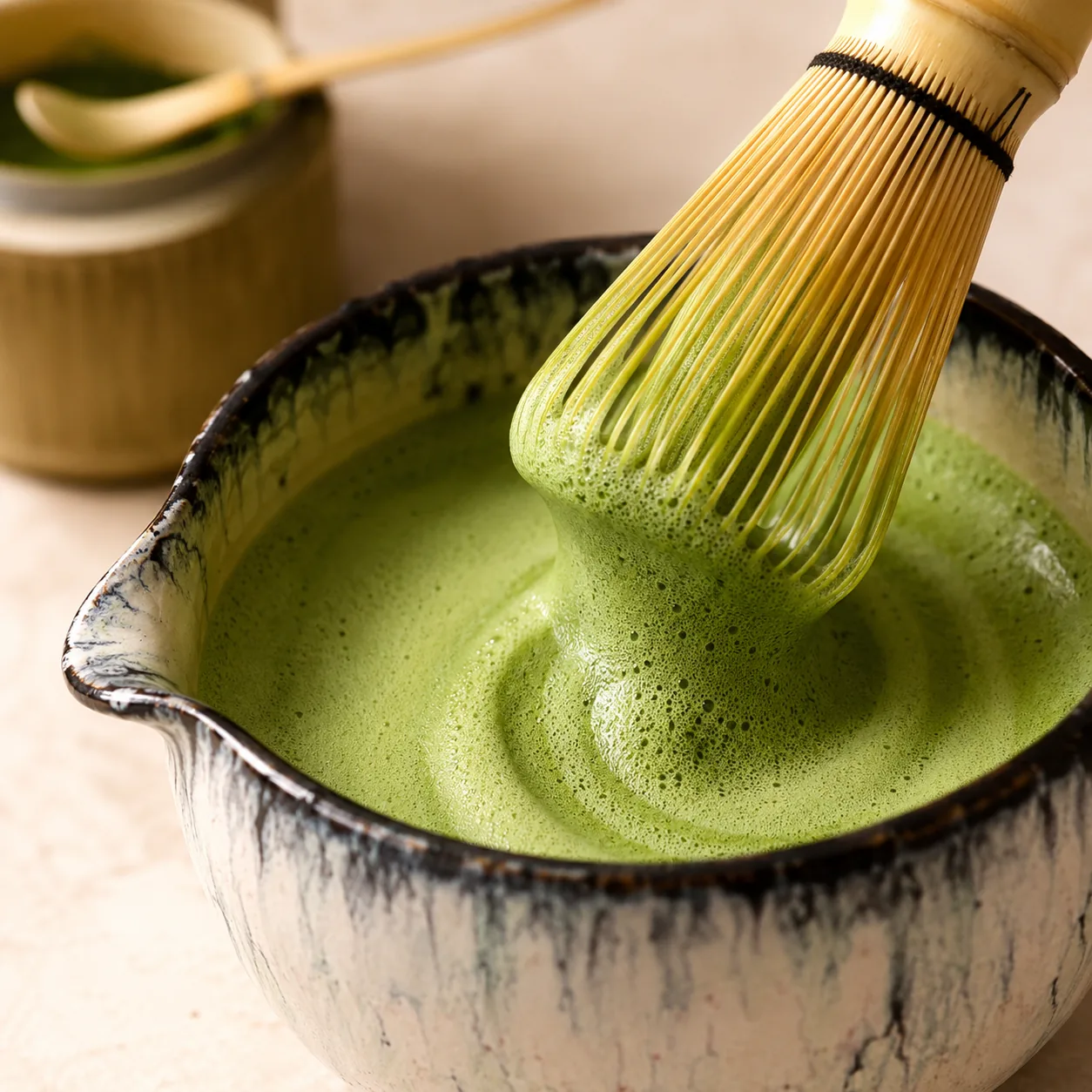
The handheld frother came into the kitchen for milk, and at some point it got pointed at a cup of matcha. Its pitch is short: press a button, foam appears, no wrist involved. The bamboo whisk asks for more — a bowl, a motion, a rest to dry on afterward — and the question people type into a search bar is what that extra motion actually changes.
This guide answers it at the level of the cup: what each tool does to the powder, what each does to the foam, and what each leaves you holding when the bowl is full. How to move a chasen once you own one is the job of our matcha whisk technique guide, and which whisk to buy is covered in how to choose a matcha whisk. Everything below follows the same hands-on standard we describe on how we test.
What each tool is built to do
The head of a frother is small, it spins fast, and every bit of its action happens at one point in the liquid. That suits milk: it foams readily, a cup of it is deep and narrow, and a vortex in the center pulls the whole column through the head in seconds. The tool was never drawn around a shallow, wide bowl of green powder and water.
Matcha is a suspension, not an infusion. There is no leaf steeping; there is powder that has to be wetted, separated, and lifted into the water evenly, and then a cap of foam raised on top. The chasen was shaped for precisely that. Dozens of thin tines fan out from the handle, their tips curled toward the surface, and the head is wide enough to cover a good part of the bowl on every pass. Moved in a W from the wrist, the tips cross the center of the bowl, reach the sides, and return, dozens of them at a time. One tool concentrates its work at a single spot. The other spreads it across the whole bowl.
In the bowl: what happens to the powder
Drop sifted matcha into water and start a frother, and the first thing you see is the funnel. The liquid climbs the walls of the cup and dips in the center, and the powder rides that current. Most of it disperses. Some of it clings to the wall above the waterline where the spinning liquid threw it, and any small clump that went into the water dry rides the current as a clump, because a vortex moves things around; it does not cut through them. The narrower the cup, the more the frother throws, which is why the tool tends to end up in a tall glass rather than a bowl.
The chasen works the other way. The tines do not spin the liquid; they cut through it. On every stroke of the W, dozens of tips slice across the bowl and back, and because the head is swept just above the floor of the bowl, powder that has settled is picked up and pushed back into suspension on each pass. The stroke reaches the sides of the bowl, so nothing sits out of range, and it reaches them from the wrist rather than from a motor, so the tips flex through the liquid instead of slamming into it. What comes out is a bowl with no chalk at the bottom and no ring of powder at the waterline. One rule holds for both tools: a clump that went into the water dry does not fully come apart in it. Sift first, every time.
On the surface: what happens to the foam
A frother makes foam the way it makes a funnel: the vortex draws air down through its center, one entry point, and shears it into the liquid at the head. In milk, that produces the thick, stable foam the tool is sold for. In water with green powder in it, the same action produces bubbles that are larger and less even, and with nothing in the liquid to hold them, they merge and pop. The cap rises fast and then thins from the center outward.
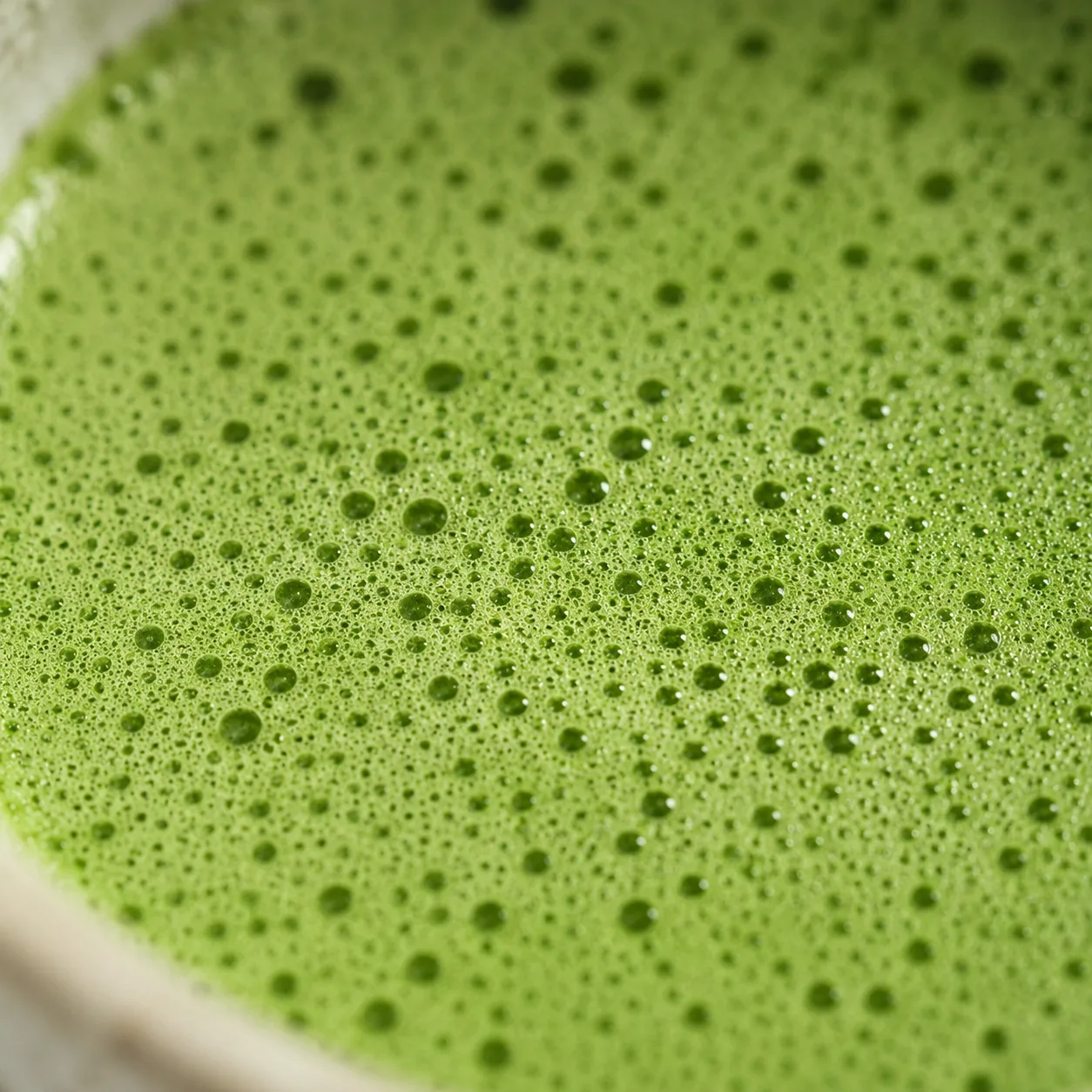
The chasen folds air in at the surface, which is where its curled tips are pointed. Each zigzag stroke drags dozens of tips across the top of the liquid, and each tip leaves a trail of small bubbles behind it; the next stroke crosses those trails and cuts the bubbles smaller still. The last pass matters as much as the first: when the cap covers the bowl, the whisk slows and skims lightly across the surface to break the biggest bubbles, then lifts out through the center. What is left reads matte and even, a cap you can rest a fingertip on, and it is still there at the last sip. Finer bubbles give a creamier mouthfeel; that is the whole reason the finishing stroke exists in tea practice, and it is a stroke a motor cannot make.
Lattes, iced matcha, and the milk question
Made properly, a latte is built in two layers. First, a concentrated matcha shot — a smaller pour of water than a plain bowl, whisked with the chasen until it is smooth and capped. Then the milk, hot or cold, and the shot poured over it. The spouted bowl in our complete 6-piece set was chosen for exactly that pour: you whisk in a wide, stable bowl and then tip the shot through the spout without losing the cap on the rim. Iced matcha is the same shot, poured through the same spout over ice.
Skip the bowl and spin the powder straight into cold milk, and two things happen. The powder streaks and settles, because cold milk wets it slowly and a vortex will not shear a dry clump. And the foam on top is milk foam, not matcha foam: the green sits underneath it, unmixed, and the first sip is mostly white. The chasen fixes both, because the shot is smooth before the milk ever meets it.
Frother and chasen, side by side
The comparison compresses into one table. Read it as what each tool does in a bowl of matcha, not in a pitcher of milk.
| Electric frother | Bamboo chasen | |
|---|---|---|
| Built for | Foaming milk in a tall cup | Whisking matcha in a wide bowl |
| How it moves the liquid | One small head, one vortex at the center | Dozens of tines swept across the whole bowl in a W |
| What happens to the powder | Carried around the funnel; dry clumps ride the current | Sheared by the tips, lifted from the bowl floor on every pass |
| The foam | Rises fast; larger, uneven bubbles that thin from the center | Fine, even cap from the finishing pass; holds through the sip |
| The vessel | A narrow glass, or it throws liquid up the walls | The wide, spouted bowl it was carved for |
| What drives it | A motor and a battery | Your wrist, and about as much attention as pouring a cup |
| Lattes and iced matcha | Whips the milk; leaves the powder streaked underneath | Makes the shot; the spout pours it over milk or ice |
| After the drink | Rinse the head | Rinse in warm water, no soap, then rest tines-down on its holder |
What we saw on the bench, and what we did not measure
Our surface check, applied to both tools. Froth consistency is one of the four checks on our how we test page: same tea, same technique, and a score for the evenness of the cap. While evaluating the chasen that ships in our set, we ran a handheld frother beside it on the same sifted matcha and the same water, then set the two bowls side by side and watched the surface. The frother's cap rose first and read coarse — a ring of larger bubbles that had thinned toward the center by the time the bowls reached the table. The chasen's cap read as a matte, even layer that was still there at the last sip, and the bottom of its bowl wiped clean without a trace of chalk. We did not put a stopwatch on the difference and we did not score flavor. The surface and the bowl floor are what we watched, and they are the rows of the table we can vouch for.
The numbers behind this comparison
the bamboo chasen included in our complete 6-piece matcha set, the whisk in this comparison, paired with the 13 cm spouted bowl it ships with
— KujiMatcha product spec sheet, 2026
of Japan's chasen production comes from Takayama, Nara, where whisks have been carved by hand for roughly 500 years — the head shape described above is that tradition's design
— KOGEI JAPAN traditional crafts directory, 2026
verified orders for the complete matcha set this comparison was run on, rated 4.9/5 by verified buyers
— KujiMatcha order data, 2026
Which tool belongs next to your bowl?
Put the two side by side and the frother's case is speed, and only speed: a button, a funnel, a cap that arrives before you have set the tin down. Everything else in the cup — the smoothness of the suspension, the fineness of the foam, how long the cap lasts, what the first sip of a latte tastes like — belongs to the chasen. So does the part that does not fit in a table. A bowl of matcha made with a bamboo whisk takes a wide bowl, a loose wrist, and a moment of attention: the sound of the tips crossing the surface, the color deepening as the cap rises, the whisk lifted out through the center. That moment is the ritual, and it is the second thing, along with texture, that a motor is built without.

The practical version of that answer is one purchase. Our complete 6-piece matcha set puts a standard 10.66 cm bamboo chasen next to the 13 cm spouted bowl it was described with above, plus the sieve that makes the powder rule easy to keep, a bamboo teaspoon, a chashaku, and a matching ceramic rest, at $49.95 in five glazes. Buyer photos of all five, foam included, are on our reviews page.
One habit follows the whisk out of the bowl. Bamboo dries in whatever shape it is left in, so between drinks the chasen goes tines-down on its rest, the piece tea practice calls a kuse naoshi; that is the whole job of the chasen holder, and the case for a fired glaze under a wet whisk is made in ceramic vs bamboo whisk holder. Rinse it in warm water first, never with soap, as our whisk cleaning guide explains. Choose the tool for the cup you want; the rest of the kit keeps it whisking.
Frother vs chasen questions, answered
Can I use a milk frother to make matcha?
A frother will get powder into water and raise a quick, coarse foam in a tall cup. What it does not do is the two things a chasen is carved for: shear the powder across the full width of a bowl and fold air in at the surface until the cap is fine and even. A bamboo whisk is the tool that makes matcha made in a bowl taste like matcha made in a bowl.
Does a bamboo whisk make better foam than an electric frother?
It makes finer foam that lasts longer. A frother pulls air down through one vortex, so its bubbles are larger and thin out quickly, especially in plain water where nothing stabilizes them. A chasen presents dozens of tine tips to the surface on every stroke, and the finishing pass breaks the biggest bubbles, which is why its cap reads matte and even and is still there at the last sip.
Can I make a matcha latte or iced matcha with a chasen?
Yes, and that is how the shot underneath a good latte is made. Whisk a concentrated bowl with the chasen, then pour it through the spout of the bowl over milk or over ice. Whatever whips the milk on top, the matcha under it wants the whisk, because powder spun straight into cold milk tends to streak and settle instead of dispersing.

Naomi Carter · Sourcing & Testing Lead, KujiMatcha
Naomi selects and tests every ceramic piece and whisk KujiMatcha sells on real, daily matcha preparations. She rejects more references than she approves.
You'll pick your color at the secure checkout step.